
Suspended Belt Magnets
DEMZ® P Series Suspended Belt Magnets
DEMZ® P series suspended belt magnets are manufactured as PP type (suspended U-shaped core) and PSh type (suspended E-shaped core). Suspended belt magnets are stationary separators that operate by means of a fixed electromagnet. They are used at mineral processing plants, building material manufacturing facilities, thermal power plants, coking plants, and other industrial sites (except underground mine workings) to protect processing equipment operating parts from damage caused by tramp ferromagnetic items. The separators are installed over conveyor discharge pulleys or suspended directly over the conveyor belt, with the former being the preferred installation method. The extraction depth and mass of extracted inclusions are specified based on transporting dry fine-grained bulk material containing dense ferromagnetic items (such as bolts and nuts) at standard conveyor belt speeds. When the separator coils are connected to a power supply, a non-uniform stationary magnetic field is generated in the operating inter-pole zone, extracting ferromagnetic items from the material stream and holding them against the magnet poles. As extracted items accumulate on the poles, periodic cleaning of the separator is performed. To discharge the collected metal, material feed onto the conveyor is briefly stopped and the separator coils are de-energized, allowing the collected items to fall onto the empty conveyor belt (the complete release time typically ranges from 0.5 to 2 minutes depending on the separator size). After cleaning, the separator is re-energized, material feed is resumed, and the operational cycle repeats. The cleaning frequency is determined on site based on operating conditions, typically ranging from 1 to 3 times per shift.
DEMZ® PP-Type Suspended Electromagnetic Belt Magnets

1 – electromagnetic separator;
2 – belt conveyor;
h – material layer thickness on the belt;
L – length;
H – height.
Table. Main Specifications of PP-Type Suspended Belt Magnets
| PP Type | Conveyor belt width, mm | Material layer thickness on belt, mm | Rated power, kW | Dimensions, mm | Weight, kg | ||
| L | B | H | |||||
| 4 | 500, 650 | 50 | 1.0 | 500 | 300 | 590 | 350 |
| 8 | 500…1000 | 160 | 1.6 | 700 | 450 | 700 | 600 |
| 10 | 800…1200 | 260 | 2.2 | 800 | 900 | 800 | 1100 |
| 16 | 1200…1600 | 350 | 2.5 | 850 | 1100 | 800 | 1300 |
| 20 | 1200…2000 | 450 | 3.5 | 1500 | 1100 | 960 | 3000 |
* Depends on the magnetic properties, shape, dimensions, and movement speed of the extracted object. Recommended for installation over conveyor belts operating at speeds up to 2 m/s. The extraction zone depth and mass of extracted inclusions are calculated based on transporting dry fine-grained bulk material containing dense ferromagnetic inclusions and standard conveyor belt operating speeds. Separator designs are subject to continuous improvement; therefore, technical parameters may differ from the values specified in the table. Table data are specified for a cylinder Ø20 mm in diameter and 100 mm in length.

Consultation
DEMZ® PSh-Type Suspended Electromagnetic Belt Magnets
A distinctive feature is the structural design of the separator body (magnetic core) — E-shaped, which produces a uniform electromagnetic field distributed across the conveyor width, as well as a deeper and longer magnetic field reach. The main advantage of PSh series magnetic separators over the PP series is a larger electromagnetic field area, which significantly increases the efficiency of extracting ferromagnetic inclusions from the material transported on the conveyor, along with greater operational convenience. They are manufactured in direct current (DC) versions (PSh type) and permanent magnet versions (P type, magnetic system material: Nd-Fe-B, (BH) max > 320 kJ/m3).
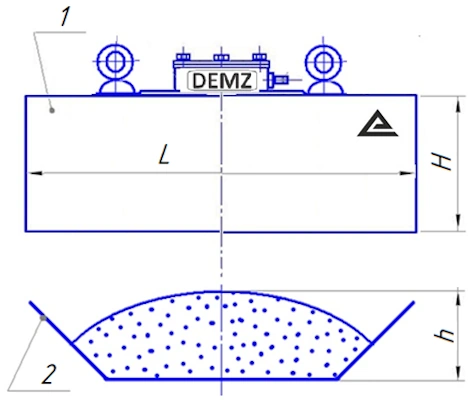
1 – electromagnetic separator;
2 – belt conveyor;
h – material layer thickness on the belt;
L – length;
H – height.
Table. Main Specifications of PSh-Type Suspended Belt Magnets
| PSh Type | Conveyor belt width, mm | Material layer thickness on belt, mm | Current at 20°C, A | Rated power, kW | Power at steady-state winding temperature, kW | Mass of extracted object, kg | Dimensions, mm | Weight, kg | ||
| L | B | H | ||||||||
| 5 | 500 | 300 | 14 | 1.5 | 1 | 15 | 550 | 550 | 550 | 490 |
| 6,5 | 650 | 360 | 23 | 2.5 | 1.6 | 15 | 670 | 670 | 650 | 910 |
| 8 | 800 | 460 | 20 | 4.4 | 2.9 | 25 | 850 | 850 | 800 | 2000 |
| 10 | 1000 | 540 | 29 | 6.4 | 4.2 | 30 | 1070 | 1070 | 900 | 3300 |
| 12 | 1200 | 620 | 37 | 8.2 | 5.4 | 35 | 1270 | 1270 | 920 | 4600 |
| 14 | 1400 | 690 | 50 | 11.1 | 7.3 | 40 | 1470 | 1470 | 1050 | 6700 |
| 16 | 1600 | 770 | 64 | 14.1 | 9.3 | 40 | 1680 | 1680 | 1150 | 9750 |
| 18 | 1800 | 840 | 81 | 17.9 | 11.8 | 40 | 1880 | 1880 | 1300 | 14000 |
| 20 | 2000 | 910 | 99 | 21.8 | 14.3 | 40 | 2100 | 2100 | 1350 | 18000 |
* Depends on the magnetic properties, shape, dimensions, and movement speed of the extracted inclusion. Recommended for installation over conveyor belts operating at speeds up to 2 m/s. The extraction zone depth and mass of extracted inclusions are calculated based on transporting dry fine-grained bulk material containing dense ferromagnetic inclusions and standard conveyor belt operating speeds. Separator designs are subject to continuous improvement; therefore, technical parameters may differ from the values specified in the table. Table data are specified for a cylinder Ø20 mm in diameter and 100 mm in length.
years in the CIS and European equipment market
units of manufactured products
units of industrial equipment repaired
types and varieties of products

Our standards

Contact Us
Frequently Asked Questions (FAQ)
The lifting capacity of an electromagnet is the maximum load weight permitted to be lifted and moved by the magnet. It typically equals 0.5 of the breakaway (tear-off) force, providing a safety factor for secure operation.
The lifting capacity depends on the magnitude of the magnetic flux in the core. The flux increases as the magnetomotive force increases and as the magnetic reluctance of the circuit decreases.
Copper coils cost twice as much as aluminum ones; copper has 1.7 times higher conductivity than aluminum; copper density is 3.3 times higher than aluminum; copper’s specific heat capacity is 3 times lower than aluminum’s; copper coils offer more repair cycles and a longer service life than aluminum.
Welded steel housings are simple and cost-effective to produce. The advantages of a cast magnetic core over a welded one include cooling fins, greater operational durability, solid structural integrity, and the complete absence of internal air gaps.
Overheating, lower density of scrap metal, switching to metal stock with larger air gaps, and malfunctions in the control cabinet (voltage converter).
Improper operation (faulty control cabinet, overheating, moisture exposure, overvoltage), coil-to-housing breakdown (ground fault), open-circuit/broken conductors, and inter-turn short circuits within the coil.